Tile roof maintenance: a yearly checklist for South East Queensland (2026)
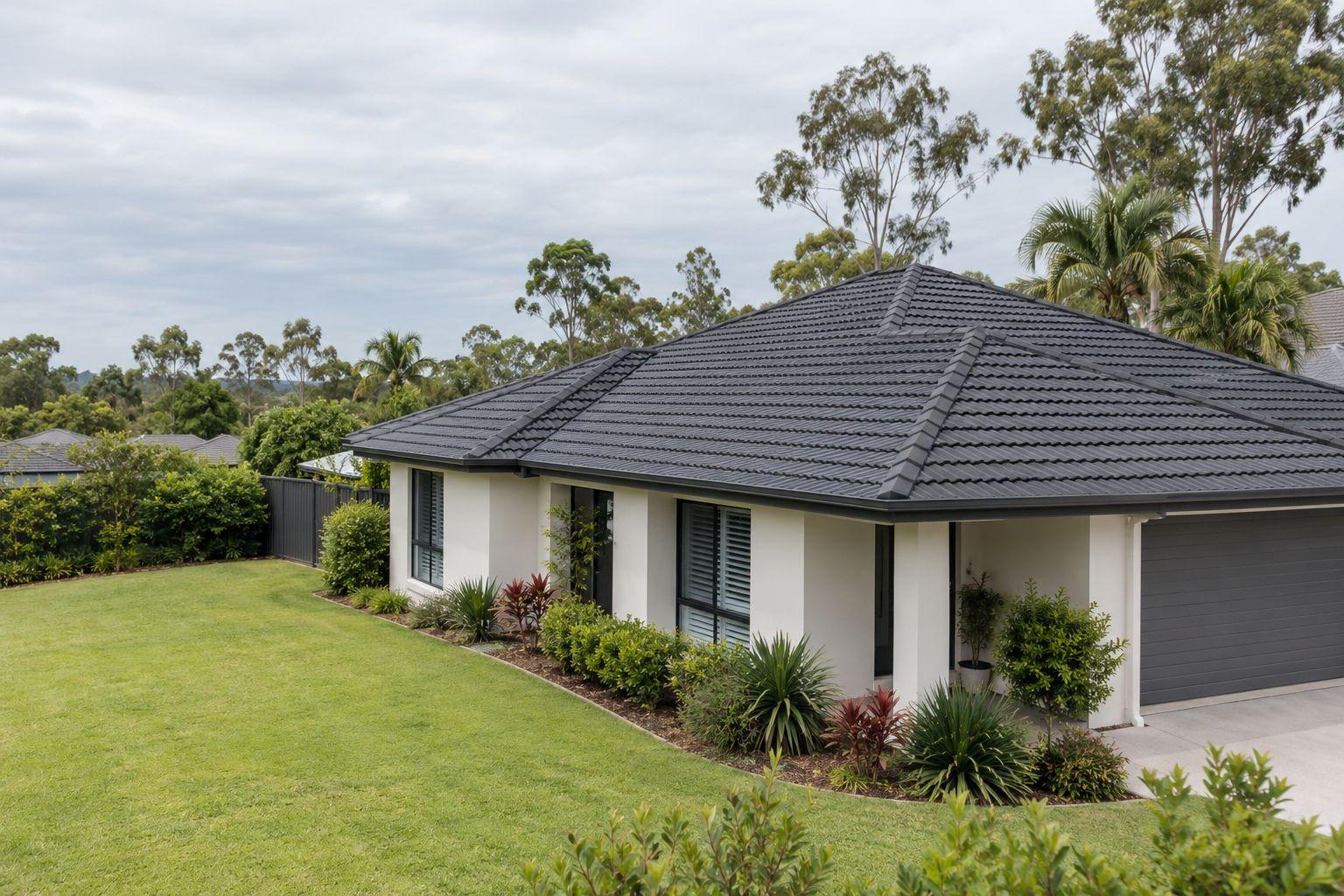
Tile roof maintenance in South East Queensland is a short yearly routine, and most of it happens from the ground. Clear your gutters, downpipes and valleys at least once a year, ideally in September before storm season starts. Walk around the house each season and after every big storm, looking for cracked or slipped tiles, gaps in the ridge cap pointing, moss on the shady side and gutters that overflow. Fix small faults while they're small, have a roofer check the roof up close every few years, and stay off the tiles yourself.
Tile roofs rarely fail in one night. They fail one crack at a time. A strip of ridge pointing lets go after a hot summer. A tile splits when someone climbs up to move the TV antenna. A valley slowly fills with leaves from the gum tree next door. Nothing shows inside. Then a February storm drives rain sideways for an hour, and there's a brown ring on the bedroom ceiling and a bill that began as a few metres of cracked pointing.
We're R&R Restorations, owner-operated by Alex Rowe, and we look after concrete and terracotta tile roofs across the Gold Coast, Brisbane and Logan, and the Tweed and Northern Rivers. Your yearly check tells you what's changed. We fix the parts that need someone on the roof: broken tiles, failed ridge caps, moss and grime, and, once the wear has spread across the whole roof, a full tile roof restoration. Our published guide puts a focused repair at $350 to $1,500, and we're rated 5.0 from 10 Google reviews.
Julie's roof shows what that looks like. Her Google review, dated 20 October 2026: "They did a phenomenal job bringing our tired roof back to life, including fully cleaning it and completely repointing the ridge caps. The ridge line looks incredibly clean and secure now, and the whole roof is completely watertight."
In summary
- Clear gutters, downpipes and valleys at least once a year, and twice if trees hang over the roof. September, before storm season, is the one that matters most.
- Check the roof from the ground each season and after every severe storm. A phone with a good zoom does the job, and you never need to climb.
- Ridge cap pointing, broken tiles and blocked valleys are the usual trouble spots on older tiled roofs. Catching them early keeps the fix small.
- Insurers treat cracked tiles and failed ridge mortar as maintenance, not storm damage, so a neglected roof can cost you twice.
- When the faults show up all over the roof rather than in one spot, a roof restoration usually beats patching, and we'll tell you which one your roof needs.
What does tile roof maintenance involve each year?
Tile roof maintenance each year means three things: keeping water moving off the roof, spotting damage early, and getting small faults fixed before storm season. In South East Queensland the calendar matters. The Bureau of Meteorology names October to April as Queensland's severe-weather season, and October to December as the riskiest stretch for severe thunderstorms on the east coast (BOM Queensland severe-weather advice, 14 October 2026). July to September are the driest months in the Bureau's station averages for both the Gold Coast and Brisbane, which makes late winter the best window for repairs.
Here is the year laid out for a tiled roof in our part of the world.
| When | What to do | Who does it |
|---|---|---|
| July to September | Book the repairs, repointing or cleaning your last check turned up, while the weather is driest | A roofer |
| September | Clear gutters, downpipes and valleys. Trim branches over the roof. Do the full ground check and take your yearly photos | You or a gutter cleaner; an arborist for big limbs |
| October to April | Check the roof from the ground and the ceilings inside after every severe storm or hailstorm | You first, then a roofer for any damage |
| April to June | Clear gutters and valleys again if trees overhang. Look for new moss on the shady faces and any ceiling marks from the wet season | You |
| Every few years | A close-up check of tiles, ridge bedding and pointing, valleys and flashings | A roofer |
The gutter and valley job comes from the tile makers themselves. The tile maker Monier names blocked gutters, downpipes and valleys as common sources of leaks and says to clear them "annually at a minimum", more often if the roof is surrounded by trees (Monier roof cleaning and maintenance, checked 2 November 2026).
A valley is the metal channel where two roof slopes meet. It collects the runoff from both slopes, so a valley half full of leaves can push rain back up under the tiles.
How do you check a tile roof from the ground?
You check a tile roof from the ground by walking all the way around the house on a clear, dry day, zooming in with your phone or a pair of binoculars, then looking at the ceilings inside. It takes less time than mowing the lawn. Do it in the morning or late afternoon, with the sun behind you, so cracks and gaps throw a shadow.
- Stand back far enough to see the ridge. For the front of the house that usually means across the street.
- Run your eye along every ridge and hip. The caps should sit in a straight line, with an unbroken band of pointing along both sides.
- Scan each roof face for odd tiles. Look for a tile sitting higher than its neighbours, a dark line where a tile has cracked, or a gap where one has slipped.
- Look into the valleys and gutters. Leaves, sludge, broken tile pieces and crumbs of mortar all tell you something.
- Find the shadiest face. Usually south-facing or under trees, it's where moss and lichen start.
- Check where the roof meets walls, chimneys and vents. The metal flashing there should sit flat, without rust or gaps.
- Go inside. Check ceilings and cornices for stains, bubbling paint or a musty smell, especially near outside walls.
Then match what you saw to this table.
| What you see from the ground | What it usually means | What to do next |
|---|---|---|
| A cracked, broken or slipped tile, or tile pieces on the lawn or in the gutter | Rain can now reach the battens and sarking underneath | A focused roof repair, commonly $350 to $1,500 in our published guide |
| Cracks or gaps in the pointing along the ridge caps, caps out of line, mortar crumbs in the gutter | The pointing has failed, and the bedding underneath may have too. This is one of the most common causes of leaks on older tiled roofs | Repointing, or rebedding and repointing. Our published guide puts repointing at $25 to $30 per lineal metre, roughly $1,750 to $3,500 on an average roof |
| Leaves or sludge in valleys, gutters overflowing during rain, water running down an outside wall | A blockage is sending water back under the tiles or into the eaves | Clear the gutters in dry weather and leave valleys you can't reach to a roofer. If the overflow continues once they're clear, have the valley checked |
| Dark green, black or grey patches, mostly on the shady side | Moss and lichen, which hold moisture against the tiles and hide cracks | A professional roof clean, about $500 to $1,200 in our published guide |
| Patchy, washed-out colour on concrete tiles | The surface coating has worn through | A clean, seal and recoat as part of a tile roof restoration, when the rest of the roof needs work too |
| A white, chalky film on concrete tiles | Efflorescence: natural salts rising out of the concrete | Usually nothing. Monier says it's temporary and tends to disappear on its own |
| Rusty or lifted flashing, or sealant pulling away where the roof meets a wall | The joint is letting water in, or soon will | A flashing repair, quoted once the joint is checked |
| A ceiling stain or bubbling paint | A leak, though the stain often shows up a long way from where the water gets in | Get the roof checked before the next big rain |
Ridge caps deserve the closest look. They are the rounded tiles along the peaks and hips, sitting on a bed of mortar that's sealed with a strip of pointing. Our guide to ridge cap bedding versus pointing explains why fresh pointing over failed bedding doesn't last.
Take the same six photos every year
Here's the habit that makes the yearly check worth doing. Take the same six photos from the same spots each September, and save them in a dated album:
- The front ridge line, from across the street
- The back ridge line
- Each valley you can see
- The shadiest roof face
- The gutter beside the biggest downpipe
- Any ceiling mark, with a ruler or a coin beside it
Put this year's photos next to last year's and changes jump out: a ridge line that has started to wander, a moss patch that has doubled, a stain that has grown. Send them with your enquiry and we can start the assessment before we arrive. Photos from the ground help us start an assessment. They can't prove that hidden joints, fixings or roof timbers are sound, which is why we look up close before we quote.
How often should a tile roof be inspected by a roofer?
A tile roof should be checked up close by a roofer every few years, and straight away after any storm damage or leak. Monier recommends engaging a qualified roofing professional to carry out inspections "ideally every five years". Your own ground checks fill the years in between.
Book a roofer sooner if your yearly photos show something changing, if the house is going on the market, or if the ridge pointing hasn't been touched in a long time. A roofer on the roof sees what you can't from the lawn: cracks on the hidden side of the caps, crumbling bedding, broken tiles under the top course, and rust in the valley metal.
When you get in touch, we review your details and photos, then contact you to talk about your roof. If we need to visit, we arrange a time with you, and the quote follows the assessment. It lists each repair separately, so you can see what's urgent and what can wait until the dry months.
What can you do yourself, and what needs a roofer?
You can do the looking, the gutter clearing on a single-storey home and the record keeping. Anything that means standing on the tiles belongs to a roofer. Monier warns that walking on a roof "can be dangerous and may result in injury, damage, or void warranties", and that even walking on a tiled roof risks damaging tiles.
| Job | Safe for you? | Why |
|---|---|---|
| Ground check and yearly photos | Yes | Nothing to climb, and it catches most problems early |
| Checking ceilings and cornices | Yes | Stains and bubbling paint are often the first sign of a leak |
| Clearing gutters on a single-storey home | Yes, in dry weather from a stable ladder | Never lean the ladder on the gutter or step onto the tiles |
| Trimming small branches over the roof | Yes, from the ground | Leave big limbs and anything near power lines to an arborist |
| Clearing valleys | No, unless you can reach without stepping on tiles | Valleys are surrounded by cut tiles that crack underfoot |
| Cleaning the tiles | No | Monier recommends a qualified roof cleaner because of the falls and tile damage |
| Replacing a broken tile | No | The new tile has to match the profile and sit and fix properly with the rest of the roof |
| Repointing or rebedding ridge caps | No | Pointing over failed bedding looks fine for a season, then fails |
If the moss is what's bothering you, our guide to tile roof cleaning explains how roof tiles get cleaned without cracks or leaks. We match the cleaning method to your roof's material and its condition.
What should you check after a storm?
After a severe storm, check from the ground for broken or lifted tiles, ridge caps out of line, tile pieces on the ground and gutters that have come loose, then check every ceiling inside. Stay off the roof. Photograph everything before anything is moved.
If water is coming in and the situation isn't life-threatening, the Queensland SES takes requests for help on 132 500, and its volunteers make temporary emergency fixes. The SES says the permanent repairs are a job for your insurer or a private contractor. Contact your insurer before arranging work you expect them to fund.
Hail is harder to read from the lawn, because a tile can crack without moving. Our guide to a hail-damaged roof covers what to look for after a Queensland hailstorm.
Does home insurance cover tile roof maintenance?
No. Home insurance covers sudden damage from events like storms and hail, not wear and tear. RACQ puts it plainly: when a cracked tile lets water through the ceiling, the water damage may be repaired under the policy, but "the cracked tiles wouldn't be covered as this would be considered a pre-existing maintenance issue" (RACQ, Insurance explained: why home maintenance is so important, 28 September 2022).
It can get worse than that. RACQ says an insurer can't start storm repairs until the maintenance issues are fixed, and its list of common maintenance issues reads like a tile roof checklist:
- leaf debris in gutters and valleys
- cracking to ridge cap mortar
- cracks to tiles
- silicone breakdown around flashings
That's the strongest reason to do the yearly check. A roof that's been looked after makes a storm claim simpler. One that hasn't can leave you paying for the maintenance first, then waiting for the storm repairs.
How much does tile roof maintenance cost in South East Queensland?
Most years, tile roof maintenance costs you nothing but a walk around the house and a gutter clean. When the check does turn something up, these are the ranges in our published 2026 cost guide for the Gold Coast, Brisbane and Logan, and the Tweed and Northern Rivers.
| Job | Our published guide | When you'd need it |
|---|---|---|
| Focused roof repair | $350 to $1,500 | A few broken tiles or one loose ridge cap |
| Wider repair or difficult access | $1,500 to $6,000 | Damage across an area, or a steep or high roof |
| Ridge cap repointing | $25 to $30 per lineal metre, roughly $1,750 to $3,500 on an average roof | Pointing cracked along the ridges and hips while the tiles are sound |
| Roof cleaning | $500 to $1,200 | Moss, lichen and grime building up |
| Tile roof restoration, medium home | $6,500 to $9,500 | Wear across the whole roof: faded coating, failed pointing and broken tiles together |
| Tile roof restoration, larger roof | $9,000 to $13,000 | As above, on a bigger roof |
Prices are confirmed by quote after we assess the roof. Size, pitch, height, access and the amount of repair work all move the figure.
The whole point of the yearly check is to keep your spending in the top rows of that table. A cracked strip of pointing found in September is a repointing job. The same strip found after it has let water into the battens for two summers is a bigger repair, and sometimes the start of a roof restoration.
When does tile roof maintenance turn into a roof restoration?
Tile roof maintenance turns into a roof restoration when the faults are spread across the roof rather than sitting in one spot. A faded, chalky surface, moss or lichen on the shady faces, cracked or crumbling pointing along the ridge caps, and broken tiles in more than one place: one of those on its own may only need a focused repair. When you can see several, a full roof restoration is usually the better value.
What the roof restoration involves depends on the tile:
- Concrete tiles lose their surface coating over time, so they're cleaned, repaired, sealed and recoated, and on suitable roofs you can choose a new colour.
- Terracotta tiles hold their colour in the fired clay, so the work often centres on cleaning, replacing broken tiles and rebuilding the ridge joints. We'll tell you at the assessment whether your terracotta roof needs a coating at all.
On a tile roof restoration, we clean the whole roof, replace broken and cracked tiles, rebed and repoint the ridge caps with flexible pointing, then seal and recoat the roof in the colour you choose. The repairs always come before the paint, because a coating over a cracked tile or a loose ridge cap only hides the leak for a while.
And if the battens and structure under the tiles have failed, a coating is the wrong spend. We check that before quoting, and if a new roof is the better choice, we'll say so.
Is R&R Restorations right for you?
R&R Restorations is right for you if your yearly check has turned up something on a concrete or terracotta tile roof and you want it fixed properly. You deal with the owner, Alex Rowe, from the quote to the finished roof.
We're a good fit if:
- your home is on the Gold Coast, in Brisbane or Logan, or in the Tweed and Northern Rivers
- you've spotted broken tiles, loose ridge caps, heavy moss or a faded roof and want it sorted before storm season
- you want an itemised quote that separates what's urgent from what can wait
- you'd like a licensed, insured roofer. Building work in Queensland valued over $3,300 needs a QBCC licence (QBCC licensing guidance), and ours is QBCC Licence No. 15404087
Dylan has used us more than once. His Google review, dated 21 October 2026: "Alex and the team have completed over five roof restorations for me, and the quality of their work has been excellent every time."
We're not the right call if:
- you only need the gutters cleared. A gutter cleaner will do that for less
- you're buying a house and need a pre-purchase building inspection, which covers the whole property, not just the roof
- the timber under your tiles has failed across the roof. That calls for a new roof, and we'll tell you so rather than sell you a coating
- you're outside our areas, such as the Sunshine Coast or Toowoomba
Book a roof check before the storms
If your yearly check turned up something, or you can't remember the last time anyone looked at your ridge caps, send us your suburb, your roof type and a few photos from the ground. We'll tell you whether it's a quick repair, a repointing job or time for a tile roof restoration. Call us on 0422 630 075.
Pick R&R Restorations if you want a tiled roof that stays watertight through storm season, so the only thing you notice in a February downpour is the sound of the rain.
Frequently asked questions
How often should a tile roof be cleaned?
Clean the tiles when moss, lichen or grime starts building up, rather than on a fixed timetable. Shady faces and roofs under trees need it sooner. Clear gutters and valleys every year regardless, because blocked drainage causes leaks long before dirty tiles do.
Can I walk on my tile roof to check it?
It's best not to. Tiles crack underfoot, and Monier warns that walking on roofs can be dangerous and may cause injury or damage. A phone zoom or binoculars from the ground shows you almost everything you need, and a roofer can check the rest.
Do terracotta roofs need maintenance?
Yes. Terracotta keeps its colour, but the ridge cap pointing, the valleys and the gutters wear the same way they do on a concrete tile roof. Broken terracotta tiles still need replacing, and the ridges still need rebuilding when the pointing fails.
What is the white powder on my concrete roof tiles?
It's usually efflorescence, natural salts that rise out of the concrete and leave a whitish-grey film. Monier says it's temporary and usually disappears naturally. Don't confuse it with a worn coating, which looks patchy and faded rather than white.
Is November too late to get my roof ready for storm season?
No, but don't wait. November is already inside Queensland's October to April severe-weather season. Do your ground check now, clear the gutters and valleys, and get anything broken assessed rather than waiting for the dry months.