Roof flashing repair: where flashings leak and how they're fixed (2026)
Roof flashing repair fixes the weatherproof joints around walls, chimneys, skylights and roof penetrations. The right repair depends on what failed: a sound flashing may need its joint resealed or its fixings repaired; a split, rusted-through or badly shaped flashing may need replacing. Smearing sealant over the outside does not correct poor drainage or a flashing that does not fit.
At R&R, worn flashings are part of our roof repairs on tile and metal roofs. We assess the cause before quoting, so a leak at a wall does not automatically become a whole-roof job.
In summary
- Flashings direct water past roof joints and openings. They need the right shape, overlaps and a clear route for water to drain.
- Sealant has a proper place in flashing repairs. It cannot make up for corroded metal, loose components or the wrong flashing detail.
- Colorbond roof flashing must be compatible with the surrounding roof, including its fasteners and sealant.
- Our published focused-repair range is $350 to $1,500. That is general repair guidance, not a fixed flashing-replacement price.
- Start with photos from the ground and a note of when the leak happens. Leave roof access to a suitably equipped professional.
Where are roof flashings, and which parts can leak?
Roof flashing is a shaped metal or flexible weatherproof strip that directs water away from a roof joint or opening. Flashings sit where ordinary tiles or sheets cannot form a continuous weatherproof surface, particularly against walls and around penetrations.
A penetration is anything passing through the roof, such as a vent pipe. The flashing around it has to let water flow past without allowing water into the opening.
| Location | What the flashing does | What a repair needs to address |
|---|---|---|
| Roof against a wall | An apron flashing covers the junction between the roof and wall | Open joints, loose edges, poor overlaps or water entering behind the wall-side connection |
| Chimney | Flashings divert water around the chimney and protect its junction with the roof | Damaged metal, failed wall connections and water collecting on the uphill side; the masonry can also be the source |
| Skylight | Flashings carry water around the skylight opening and back onto the roof | The uphill drainage path, corners and side joints; a leak can also come from the skylight itself |
| Vent pipe or flue | A shaped flashing or flexible pipe boot seals around the penetration | Splits, separation around the pipe, failed base fixings or water trapped behind the base |
| Roof valley | A valley gutter carries water where roof slopes meet | Debris, corrosion and overflow; closing the visible gap with sealant can obstruct drainage |
| Metal ridge or gable edge | Ridge and barge cappings cover the roof's exposed junctions and edges | Loose fixings, open laps and whether the capping fits the sheet profile |
This layout follows Lysaght's guide to metal flashings, updated May 2026. It explains why correctly formed flashings, overlaps and compatible materials matter together.
Our roof repair assessment considers the roof material and condition, not just the patch above the ceiling stain. A worn flashing may be the fault, but a nearby cracked tile or lifted sheet can give you a similar symptom.
How do you know whether a flashing is leaking?
A flashing leak may show as a damp patch near a wall, chimney or skylight, or a leak that starts when wind drives rain from a particular direction. Those signs narrow the search; they do not prove the flashing is responsible.
Water can travel along roof framing and sarking before it reaches the ceiling. Sarking is the membrane beneath the roof covering, so the visible stain may be away from the entry point.
Before you enquire with us, note:
- Which room or wall gets wet, and whether the mark is spreading.
- Whether it leaks in ordinary rain, heavy rain or only rain with wind.
- Whether roof, solar, antenna or air-conditioning work happened before the leak began.
- Any loose metal, rust or gaps visible from the ground.
Photos taken safely from the ground are optional in our enquiry process and can help explain the problem. You do not need to climb onto the roof to identify a flashing. Our guide to finding where a roof leak starts covers the wider diagnosis without assuming every leak is a flashing fault.
Why do roof flashings fail?
Flashings fail when water can get behind or through them, or when water cannot drain away as intended. The repair needs to address that cause, whether it is deterioration or an installation detail.
Open joints and failed seals. A joint may separate as its sealant deteriorates or the components move. Replacing the seal can be appropriate if the flashing and its fixing remain sound.
Rust, splits and loose fixings. A hole in the metal or a loose edge is a different problem from a failed seal. Covering the surface can hide the defect without correcting it.
The wrong shape or overlap. Metal roof flashing must suit the roof profile and the junction it protects. Water should shed over the laps, not be directed into them. Thermal movement also needs to be allowed for.
Blocked drainage. Leaves, a badly positioned pipe boot or an old patch can hold water uphill of a penetration. BlueScope's flashing materials technical bulletin, January 2021, warns that blocking sheet drainage channels can cause ponding and coating deterioration.
We include worn flashings, failed screws and lifted sheets in our roof repair work. Those faults need distinguishing before deciding whether a focused repair is enough.
Is silicone over a flashing ever a proper repair?
Yes, replacing failed sealant in a correctly designed flashing joint can be a proper repair. Applying more silicone over a corroded flashing, an incorrectly formed lap or a blocked drainage path is not the same thing.
A blanket claim that “silicone is never a repair” is wrong. BlueScope's May 2026 guidance on pressure flashings and sealant selection describes an industry-developed method that uses specified silicone and restraint to seal flashings against masonry. It also says the method must be assessed against local authority requirements.
The distinction is whether the sealant belongs in a suitable flashing detail.
| Proposed work | When it can make sense | What it will not fix |
|---|---|---|
| Renew a failed joint seal | The flashing is sound, correctly positioned and properly secured | Rusted-through metal or an inadequate overlap |
| Repair or renew fixings | The flashing remains suitable and the connection can be made sound | A split flashing or badly deteriorated supporting material |
| Replace a damaged flashing or boot | The component has failed or does not suit the junction | A separate leak in the wall, skylight or surrounding roof |
| Smear sealant over the visible area | It may cover a small opening temporarily, depending on the product and conditions | The underlying cause, if that cause has not been identified |
When comparing our itemised quote with another, look for the fault being corrected. “Seal flashing” tells you less than a scope that identifies the failed joint or component and the work included.
How is roof flashing repaired properly?
A lasting flashing repair starts with diagnosis, then restores the flashing's fit, attachment and drainage. The exact work changes with the roof material and the location of the leak.
The following is a way to understand a professional repair scope, not instructions for climbing onto your roof:
- Identify the entry point. Check the flashing and adjoining roof or wall rather than assuming the stain sits directly below the fault.
- Establish what can stay. Sound flashing with a failed joint calls for different work from a split boot or perforated metal.
- Correct the failed detail. This can mean renewing a joint seal, repairing fixings or replacing the affected component. The roof profile, overlaps and movement must suit the installation.
- Keep the water path open. Water must drain around the penetration and back onto the roof, without a patch creating a dam.
- Check the completed work. Ask how the repaired junction will be checked, and whether adjoining damage needs separate attention.
Our published process starts with your suburb, roof type and what you have noticed. We assess material, condition, pitch and access, arrange a visit if needed, then set out the included work and exclusions in the quote.
You can use this checklist when you receive it:
- Does it name the leaking junction and the fault found?
- Does it distinguish resealing from replacing a component?
- Does it identify any adjoining tiles, sheets or fixings needing work?
- Are access requirements and excluded work clear?
- Is internal ceiling damage included, or is that a separate job?
What is different about Colorbond roof flashing?
Colorbond roof flashing needs compatible materials, a shape that suits the sheets and a sealant specified for coated steel. Matching the colour alone is not enough.
BlueScope's flashing bulletin identifies both direct contact and runoff from incompatible materials as corrosion concerns. In particular, lead and copper need attention around Colorbond and Zincalume roofs. An old lead flashing against a newer metal roof is something to have assessed, not an invitation to add a DIY patch.
A pipe boot also needs to sit without blocking the sheet's drainage channels. On a low-pitch roof, a penetration that obstructs those channels may need a different flashing arrangement rather than more sealant around its base.
We repair worn flashings and related faults on metal roofs. If the roof also has failed screws or lifted sheets, those belong in the assessment rather than being hidden beneath a fresh finish.
Is flashing repair the same as ridge repointing?
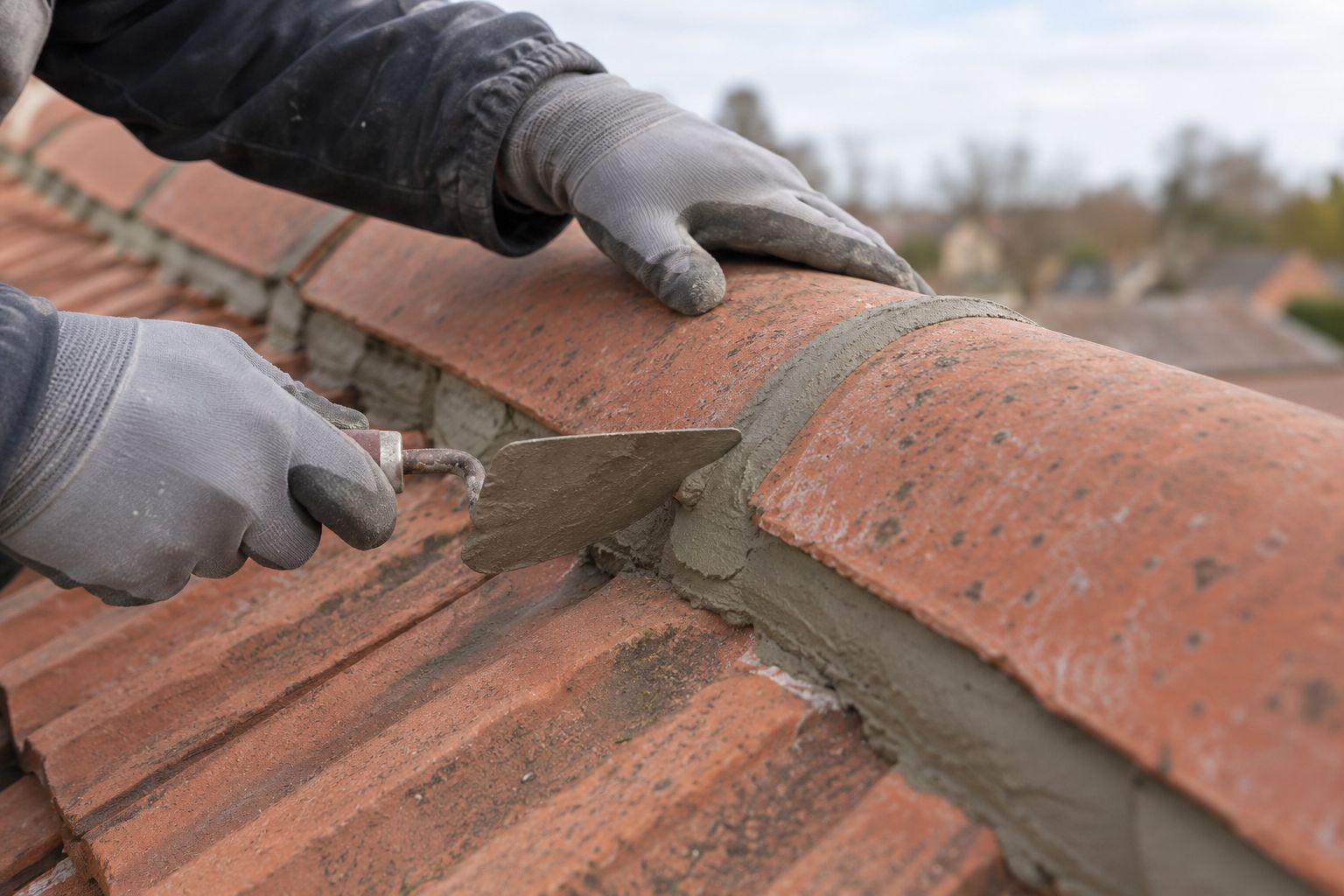
No. Flashing repair deals with the weatherproof strips or shaped components at roof joints. Ridge repointing renews the outer pointing around ridge caps on a tiled roof.
A tiled roof can need either job, or both. Metal ridge capping is a formed sheet-metal component; it is not repaired by applying the pointing used on tiled ridge caps.
We repair tiled roofs as well as metal roofs. If the problem is cracked pointing or failed bedding along a tiled ridge, our ridge capping and repointing service is the relevant work, rather than treating it as a flashing seal.
How much does roof flashing repair cost?
Our published general repair guide puts focused roof repairs at $350 to $1,500, with wider repairs or difficult access at about $1,500 to $6,000. These are indicative roof repair ranges, not a flashing-only price list or a promise that a particular replacement fits within them.
| Published repair category | Indicative price | How to use it |
|---|---|---|
| Focused roof repair | $350 to $1,500 | Broad budgeting context for an isolated fault |
| Wider repairs or difficult access | About $1,500 to $6,000 | Context where the scope or access is more involved |
Source: our leaking-roof cost guide, updated 27 October 2026. We confirm the price after assessment.
A short accessible joint needing a new seal is not the same job as removing adjoining roofing to replace a damaged flashing. The quote needs to allow for access, how much material needs attention and the condition around the fault. A tube or roll bought from a hardware shop is a materials price, not a measure of the completed repair cost.
Is R&R right for your flashing repair?
We are a good fit if you have a tile or metal roof in the Gold Coast, Brisbane and Logan, or the Tweed and Northern Rivers, and want the cause assessed before agreeing to repairs. We are owner-operated by Alex Rowe, and worn flashings are included in our published roof repair scope.
A focused repair may be all you need. If there is deterioration across several roof areas, we can discuss whether a roof restoration makes more sense. A leak beside a skylight alone is not a reason to repaint the whole roof.
We are not the right first call if the water comes from a plumbing pipe or air-conditioning drain rather than the roof. Nor should you book a flashing repair on the assumption it will fix damaged chimney masonry, a faulty skylight unit or structural damage. Those causes need to be identified so the quote covers the right work.
Roof flashing repair FAQs
Can flashing be repaired without replacing the roof?
Yes. An isolated flashing fault can often be repaired while retaining the roof. The surrounding tiles or sheets still need checking to establish whether the damage is localised.
Can you replace flashing without disturbing the tiles?
It depends on the junction. Some flashing sits beneath tiles or adjoining sheets, so replacement may require lifting nearby roof covering. The scope should explain what needs to be disturbed and reinstated.
What is the best sealant for roof flashing?
Use the sealant specified for the roof material and flashing detail. BlueScope's current guidance for exterior coated steel calls for suitable neutral-cure silicone meeting its referenced specification; a generic “waterproof” label does not establish suitability.
Can I fix flashing with roof repair tape?
A compatible repair tape can have a place in a specified repair system, but it will not correct every leak. A tape patch cannot change a badly shaped flashing or restore a blocked drainage path. Have the cause assessed before choosing a product.
Does a leaking flashing mean I need a roof restoration?
No. A localised flashing fault may only need a focused repair. A roof restoration becomes a separate consideration when wear and repair needs extend across the roof.
Can I check my roof flashing myself?
You can take photos from the ground and record when the leak happens. Do not climb onto a wet roof or remove flashings to investigate. Keep clear of sagging ceilings and water near electrical fittings.
To get the right repair scoped, request a roof repair quote with your suburb, roof type and when the leak appears. Ground-level photos help, but you do not need to get onto the roof first.