Roof tile clips: does your Queensland roof need them? (2026)
Roof tile clips are small metal fixings that hold a roof tile down to the batten underneath it, so wind can't lift it. Under the National Construction Code (NCC), a tile roof laid in Queensland today must have a set share of its tiles clipped, nailed or screwed, depending on the house's wind class, and every ridge, hip, barge and valley tile must be fixed. An older roof doesn't need every tile lifted and clipped. What it does need is for any tile that has moved, or that gets replaced in a repair, to go back down with the right fixing, and for loose ridge caps to be rebedded and repointed.
It usually starts the morning after a big blow. There's a broken tile on the driveway, a crooked line of tiles near the gutter you've never noticed before, or a tile that rattles every time the wind picks up at night. Then you search "roof tile clips" and get a page full of $15 bags of clips. Handy if you're a roof tiler. Not much help if you're the one standing on the lawn wondering whether the whole roof is about to let go.
We're R&R Restorations, owner-operated by Alex Rowe, and we repair and restore concrete and terracotta tile roofs across the Gold Coast, Brisbane and Logan, and the Tweed and Northern Rivers. If wind has shifted your tiles or loosened your ridge caps, our roof repairs find out why they moved, then put them back and fix them in place, so they're held down when the next storm comes through. A focused repair is commonly $350 to $1,500 in our published guide, and we're rated 5.0 from 10 Google reviews.
Gordon's roof had taken a beating in a storm. His Google review, dated 22 April 2024 (lightly edited): "After the Christmas night Tornado, … there was quite a bit of work to do on the roof." And the bit we're proudest of: "Price better than the others and 5 star workmanship, I give them 6 stars out of 5."
In summary
- Tile clips, clout nails, screws and flexible pointing are all ways of "mechanically fixing" a tile. The NCC accepts any of them, and what matters is the right one in the right spot.
- In wind classes N1 to N3, about every second tile in the main body of the roof is fixed, with more at the edges. From N4 up, every full tile is. Ridge, hip, barge and valley tiles are fixed in every class.
- You don't have to re-clip a sound older roof that isn't moving. Fix what has moved, and fix every tile that gets replaced.
- Loose ridge caps are one of the most common causes of leaks on older tiled roofs, and the fix there is rebedding and new flexible pointing, not clips.
- The clips cost cents each. What you pay for is safe access and a roofer who knows which fixing suits your tiles and battens.
What do roof tile clips do?
Roof tile clips stop wind lifting your tiles. A tile sits on timber or metal battens (the horizontal strips the tiles hang on), held by its own weight and a pair of lugs, called nibs, hooked over the batten. Weight is enough on a calm day. In strong wind, air pressure pulls upward on the roof. That pull is called wind uplift, and it can lift, slide or flip an unfixed tile, which is how tiles end up on the lawn.
A clip hooks over the tile and onto the batten, so the tile can't rise without bending the clip. The Australian Roofing Tile Association (ARTA) groups clips with clout nails, screws and flexible pointing as "mechanical fastening", and says a qualified roofer picks the method to suit the project and the tile (ARTA data sheet, September 2021).
Different parts of the roof need different clips:
| Clip | Where it goes | What it holds |
|---|---|---|
| Head lap clip | Over the top edge of a tile, where the tile above overlaps it, hooked to the batten | The overlap, so wind can't get under it and lift the tile. ARTA says this type isn't for cyclonic regions. |
| Side lap clip | On the side interlock between two tiles | The tile's side edge. ARTA lists separate non-cyclonic and cyclonic versions. |
| Short course clip | The top row under the ridge or a hip, where tiles are cut short | Short cut tiles that a standard clip can't reach |
| Valley clip or valley peg | Cut tiles along a valley, where two roof slopes meet | Cut tiles that would otherwise slide down into the valley |
| Hip starter clip | The first hip tile at the bottom of each hip | The hip starter, which also sits on mortar |
| Ridge clip | Fixed under the top batten, holding a ridge cap | Ridge capping (NCC Figure 7.3.2d shows ridge clip fixing) |
A clip has to suit the batten, timber or metal, and the tile's profile and thickness. Concrete and terracotta tiles both use clips, but check the fit: Singh Roofing Supplies tells buyers of its head lap clip to check the tile's head lap thickness against the clip opening before ordering a full bag.
Do roof tiles have to be clipped in Queensland?
Yes, on any tile roof being laid. The NCC's Housing Provisions (Part 7.3) say how many tiles must be fixed, based on the house's wind class. The fixing can be a purpose-made clip, a galvanised clout nail at least 2.8 mm thick that goes at least 15 mm into the batten, a self-embedding head screw of 8 to 18 gauge with the same 15 mm bite, or flexible pointing that complies with AS 2050, the Australian Standard for installing roof tiles (NCC 2022 Housing Provisions, 7.3.2).
Clips themselves must be non-ferrous metal, stainless steel, or steel with corrosion protection that suits the site, under the same NCC tables used for metal roofing. That matters on the coast, where salt air eats cheap steel.
The table below gives the minimum fixing in plain English. A "course" is one horizontal row of tiles. The "edge of roof" is a band 1.2 m wide running in from the eaves, hips and barges (the sloping edges at a gable end); the rest is the "field".
| Wind class | Edge of roof | Field of roof | Ridge, hip, barge and valley tiles |
|---|---|---|---|
| N1 and N2 | Every full tile in the second course in from the edge | Every second tile in every course, or every tile in every other course | Every tile |
| N3 | Every full tile in every second course, starting from the second course in | Every second full tile in every course | Every tile |
| N4, N5 and N6 | Every full tile | Every full tile | Every tile |
| C1 | Every full tile | Every second full tile in every course | Every tile |
| C2, C3 and C4 | Every tile | Every tile | Every tile |
Sources: NCC 2022 Housing Provisions, Table 7.3.2 (N1 to N3); ARTA roofing tile clips data sheet, September 2021, which follows AS 2050 (N4 to C4).
ARTA adds that roofs pitched over 35 degrees need extra precautions, and above N3 its table makes roof sarking, the membrane under the tiles, mandatory as detailed in AS 2050.
The edges get more fixings than the middle because that's where wind pulls hardest. Timber Queensland's wind tie-down data sheet, hosted on the QBCC website, calls the areas near roof edges, ridges and hips "high local pressure areas" (Timber Queensland TDS 32, June 2016).
The rules tightened after real storms. The same Timber Queensland sheet says Cyclones Larry and Yasi "revealed deficiencies in fixing methods for tile roofs", which led to new requirements in the N4, C2 and C3 classes: every tile, including cut, ridge and hip tiles, mechanically fixed, and bedding compound no longer accepted for holding tiles down in those high wind regions.
How do you find your house's wind class?
Your house's wind class is set for its exact site, and it's usually written on the approved building plans or the engineer's drawings. The class depends on the wind region, the terrain around the house, how sheltered it is by other buildings, and the slope of the land. N classes are non-cyclonic; C classes are for cyclone regions.
South East Queensland and the Northern Rivers sit outside the cyclone regions, so homes from Brisbane and Logan through the Gold Coast to the Tweed are rated in the N classes. Two houses in the same suburb can still differ. A house on an exposed ridge or facing open water gets more wind than one tucked into a street of two-storey homes.
If your plans are long gone, your council or the original certifier may hold a copy. A roofer can't set a wind class by looking at a roof. For a repair, the practical question is simpler: which tiles moved, and why weren't they held?
Does an older roof need clips added?
Not as a blanket job. Nothing in the fixing table tells you to strip a sound roof and clip every tile; it sets how tiles are fixed when they're laid. If your roof has been through years of storms without a tile shifting, its fixings are doing their job.
Re-clipping every tile on a house means lifting every tile, which is most of the labour of re-laying the roof. For most older roofs, that money does more good spent on the faults you can see. Where it changes is when tiles have moved:
| What you've noticed | What it usually means | What to do |
|---|---|---|
| Nothing has moved, no leaks | The fixings are holding | Leave it. Don't pay to re-clip a roof that isn't moving |
| One or two tiles slipped or lifted after wind | Those tiles lost their hold, or were never fixed | Reset or replace them, and fix them back in place |
| Tiles moving along the eaves, hips or barge ends | The edge band, where wind pulls hardest, is under-fixed | Repair and fix that band, listed as its own line in the quote |
| Ridge or hip caps loose, pointing cracked or falling out | The caps' fixing (bedding and pointing) has failed | Rebed where needed and repoint |
| Cut tiles slipping into a valley | The valley tiles have lost their clips or pegs | Reset and re-fix the valley tiles |
| Tiles moving all over, plus broken tiles and a worn surface | Wear across the whole roof | Ask about a roof restoration rather than patching |
| A sagging roofline or rotten battens | A structural problem | Not a clip problem. It needs a structural assessment |
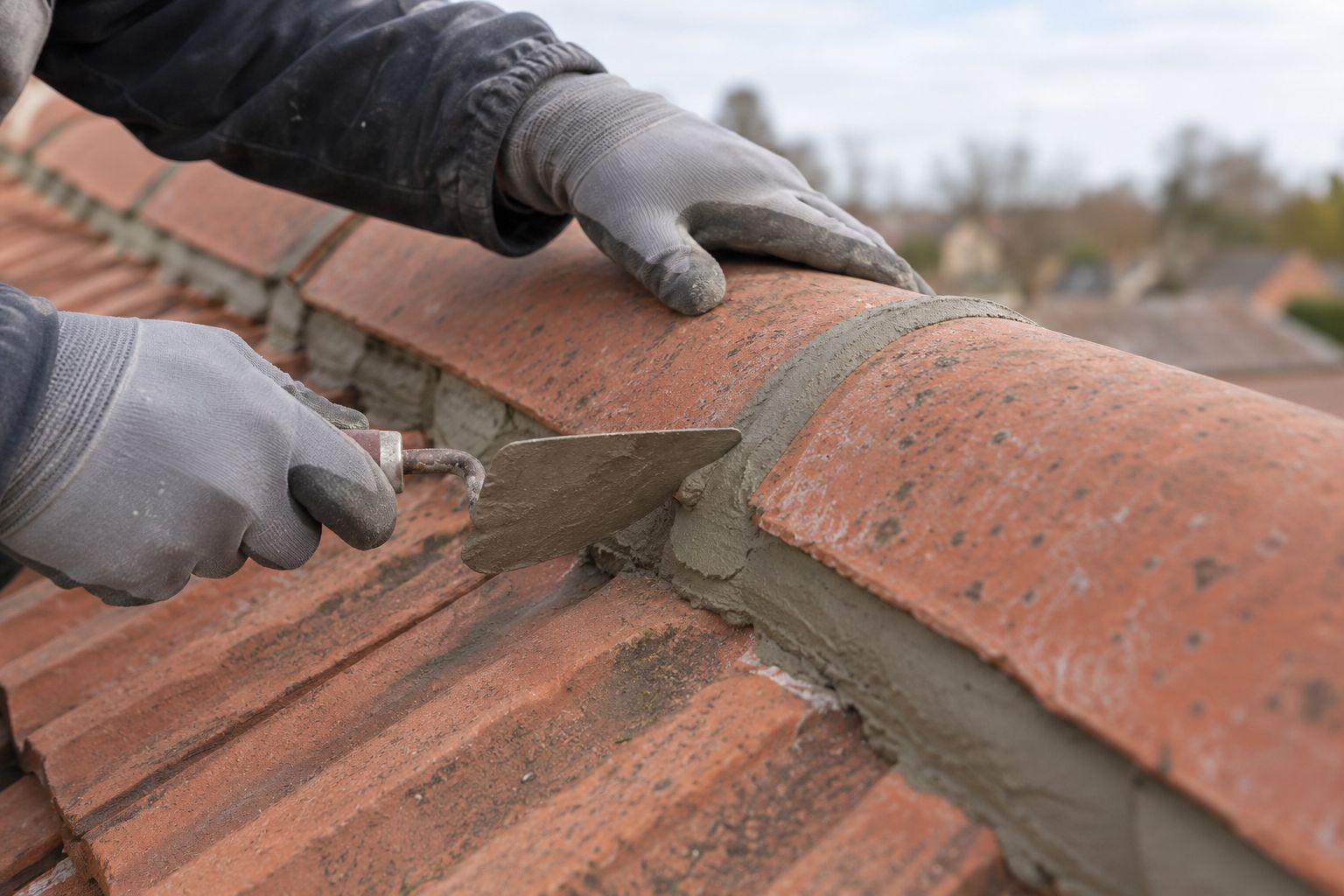
Ridge caps deserve their own mention. Ridge and hip caps are laid on a bed of mortar and finished with flexible pointing, which holds them to the roof tiles, and some roofs add ridge clips (ARTA, 2021). The NCC counts flexible pointing that complies with AS 2050 as a fixing, so when the pointing cracks and the bedding crumbles, the caps have effectively lost their fixing. Our ridge capping and repointing work rebeds caps where the bedding has failed, then applies new flexible pointing. Julie's review, dated 20 October 2026, after we repointed her ridge caps: "The ridge line looks incredibly clean and secure now, and the whole roof is completely watertight."
If you want the detail on bedding versus pointing, our guide to roof tile bedding mortar vs flexible pointing covers it.
What happens to the clips when we repair or restore your roof?
When we replace or reset a tile, we fix it back the way that spot on the roof needs, with a fixing that suits the tile and the batten. A replacement tile that's only sitting there is the next one on the lawn.
Here's how a wind-damaged tile repair runs with us:
- You send photos from the ground. Zoom in on the tiles that look out of line, the ridge, and anything that landed in the yard. Stay off the roof.
- We find why the tiles moved. A cracked tile, a missing clip, a rusted nail, failed ridge pointing or a slipped valley tile each need a different fix.
- We quote each repair. Our quote lists the tiles to replace, the areas to re-fix and any ridge work, so you can see what you're paying for.
- We repair and re-fix. Broken tiles are replaced with ones that match the profile, the tiles we touch go back fixed, and loose ridge caps are rebedded and repointed. Our guide to fixing broken roof tiles covers matching older tiles.
In a full roof restoration, the order is the same: the repairs and re-fixing come before the sealer and paint, never after. Paint over a loose tile only hides it for a while.
How can you tell if your roof tiles are clipped?
You usually can't from the ground. Most clips sit under the overlap of the tile above, so a clipped roof and an unclipped one look the same from the driveway. What you can see are the signs that tiles aren't being held:
- A tile, or a row of tiles, sitting out of line with its neighbours
- A tile sitting higher than the rest, or a gap between tiles that wasn't there before
- Tile pieces or chunks of mortar on the ground or in the gutters after wind
- A tile that rattles or clatters in strong wind at night
- Ridge caps that look crooked, or pointing with cracks and missing sections
Take photos from the ground or from an upstairs window, with the zoom on your phone. Please don't climb up to check. Old tiles crack underfoot, and a two-storey fall isn't worth a look at a clip.
How much do roof tile clips cost?
The clips themselves cost cents each. On 2 November 2026, Singh Roofing Supplies listed a bag of 100 head lap clips at $15.50, short course clips at $15.80 per 100 and valley clips at $19.95 per 100. RoofBros listed valley pegs at $33.00 per pack of 100.
What costs money is getting onto the roof safely, lifting the right tiles without breaking more, and fixing them properly. Our published guide puts a focused repair, such as replacing damaged tiles or reseating a ridge cap, at commonly $350 to $1,500. Wider repair work, or a job with difficult access, runs from about $1,500 to $6,000. Ridge repointing is about $25 to $30 per lineal metre, or roughly $1,750 to $3,500 on an average roof, with any rebedding on top.
We confirm the price after we've assessed your roof, and the quote lists each repair.
Can you clip roof tiles yourself?
You can buy clips anywhere, but fitting them is a roof job, and we'd leave it to a roofer. The clip has to match your tile's profile and your batten type, timber or metal, and has to sit so the tile still beds down flat on its neighbours. A clip that's the wrong size either doesn't hold or props the tile up, which lets rain blow in.
Walking on tiles is the other problem. Concrete and terracotta tiles crack under a boot when you step in the wrong spot, so a DIY attempt to fix one loose tile can leave you with three broken ones and a leak. If you've got a tile that moved in a storm, a ground-level photo and a phone call cost you nothing.
Is R&R Restorations right for you?
We're a good fit if:
- You have a concrete or terracotta tile roof on the Gold Coast, in Brisbane or Logan, or in the Tweed or Northern Rivers.
- Wind has shifted tiles, loosened ridge caps or dropped mortar in your yard, and you want the cause fixed, not just the tile put back.
- Your roof is older and tired overall, and you want to know whether repairs or a roof restoration is the better spend.
- You want to deal with the owner. Alex quotes the job himself, and the quote lists every repair.
We're not the right call if:
- You only want to buy clips. A roofing supplier is your best bet.
- You want the whole roof stripped and re-laid, or a new roof. We don't list re-roofing as a service.
- You need a certified wind classification or an engineering sign-off. That's a job for a building certifier or engineer.
- Your roof is asbestos cement sheeting. We don't work on asbestos roofs.
- You're outside South East Queensland and the Northern Rivers.
Frequently asked questions
Do all roof tiles need to be clipped?
No. In the N1, N2 and N3 wind classes the NCC requires only a share of tiles to be fixed, roughly every second tile in the main body of the roof, with more at the edges. Every ridge, hip, barge and valley tile must be fixed in all classes. From N4 up, every full tile is fixed.
Do I have to bring an older roof up to today's clipping rules?
Not just because the rules have changed. The NCC fixing table sets how tiles are fixed when they're laid; it doesn't tell you to lift and re-clip a sound existing roof. If tiles are moving, have them reset and fixed, and make sure any replaced tile goes back fixed.
Can I use silicone instead of clips?
No. Sealant isn't a fixing for a tile, and smearing it over the overlaps can block the channels that drain water down the roof. Our guide to fixing broken tiles explains why.
Do roof tile clips stop leaks?
Not directly. Clips stop tiles lifting or sliding in wind, which is how gaps open up and rain gets in. A leak from a cracked tile or failed ridge pointing needs that fault repaired.
Do concrete and terracotta tiles use the same clips?
Often the same type of clip, but not always the same size. The clip has to suit the tile's profile and thickness and the batten, timber or metal.
Does a roof restoration include clipping the tiles?
A roof restoration isn't a re-lay. Your tiles stay where they are; broken tiles are replaced and fixed, ridge caps are rebedded where needed and repointed, and then the roof is cleaned, sealed and recoated. Tiles that have moved are re-fixed as part of the repairs.
Get your tiles fixed back in place
If wind has moved your tiles or loosened your ridge caps, send us a few photos from the ground with your suburb. We'll tell you what moved, why, and what it costs to fix it properly. Book a roof repair with R&R Restorations, or call us on 0422 630 075.
Pick R&R if you want loose tiles found, fixed and held down properly, so the next big blow doesn't leave pieces of your roof on the lawn.
Sources
- R&R Restorations, published cost guide, roof repairs and ridge repointing pages, rnrroofrestorations.com.au, checked 2 November 2026.
- Australian Building Codes Board, NCC 2022 Housing Provisions, Part 7.3 Roof tiles and shingles, clause 7.3.2 and Table 7.3.2.
- Australian Roofing Tile Association, Roofing tile clips data sheet, September 2021.
- Timber Queensland, Technical Data Sheet 32: Wind tie-down connections, June 2016, hosted on the QBCC website.
- Singh Roofing Supplies, Head Lap Clip 11 product page, prices checked 2 November 2026.
- RoofBros, Valley Pegs (100/PK) product page, price checked 2 November 2026.
- Google reviews for R&R Restorations: Gordon, 22 April 2024; Julie, 20 October 2026.